
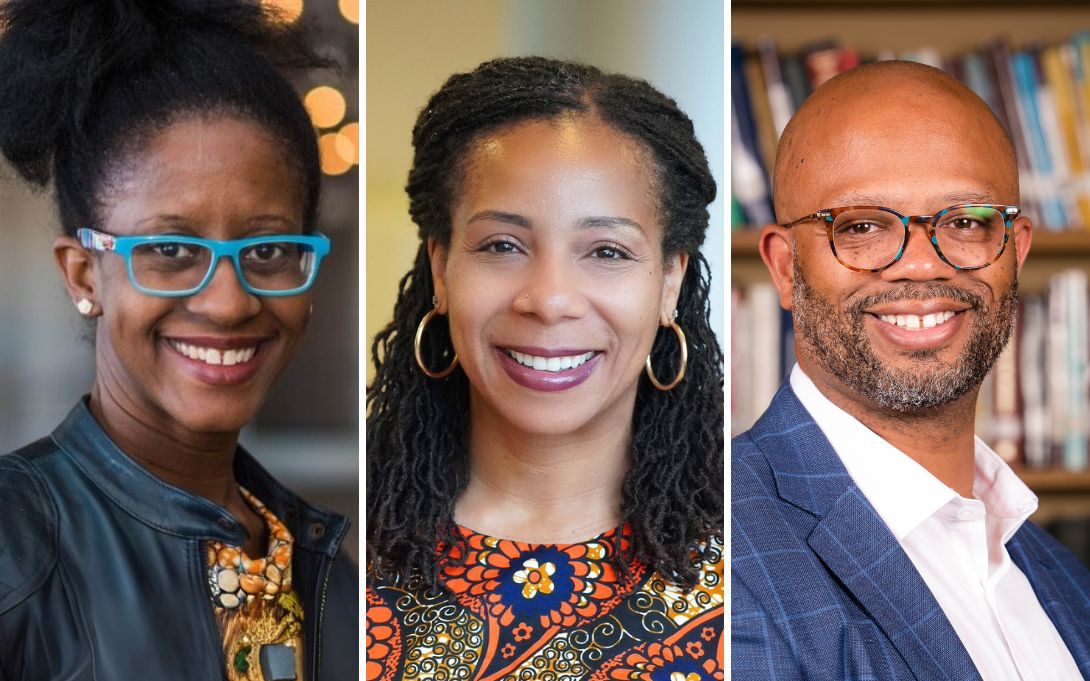
The Ford School’s Center for Racial Justice proudly welcomes R. L’Heureux Lewis-McCoy, Ayesha B. Hardaway, and Holly Bass as visiting fellows for the 2025-26 academic year.
The Visiting Fellows Program, a signature initiative of the Center for Racial Justice, offers a cohort of racial justice leaders, activists, artists, advocates, and scholars a prestigious, highly competitive fellowship designed to support their transformative work and provide opportunities to strengthen their impact within the policy landscape.
“Initiatives like our Visiting Fellows Program are vital because they bring visionary changemakers into direct dialogue with our policy community,” said Dr. Dom Adams-Santos, managing director of the Center for Racial Justice. “My hope for this year’s fellows is that they not only find the Ford School and U-M to be a supportive and generative space for their transformative work, but also that their presence sparks new collaborations and fresh ways of approaching policy change.”
R. L’Heureux Lewis-McCoy (PhD '08) is an associate professor at New York University in the Sociology of Education program in the School of Culture, Education and Human Development. His work and activism center issues of race, place, education, and opportunity. He is working on two projects: assessing the feasibility of a national survey on suburban experiences that center communities of color, and building a cross-disciplinary network of scholars interested in studying the suburbs. He is also an alum of the Ford School, graduating in 2008 with a joint PhD in Public Policy and Sociology.
“I am looking forward to being in conversation with scholars at U of M, from students to faculty, who take the issue of racial justice seriously,” said Lewis-McCoy. “In a time when many are dissuaded from talking about race, racism, and racial justice, the Ford School maintaining this space is even more critical.”
Ayesha Bell Hardaway, JD, is a Professor of Law at Case Western Reserve University where she serves as Director of the Law School’s Social Justice Law Center and its Criminal Defense Clinic. Her research and scholarship interests include the intersection of race with constitutional law, criminal law, policing, and civil litigation. Her forthcoming book examines how political allegiances and judicial decision-making have bolstered police union power and expanded collective bargaining rights beyond their original purpose.
“I hope to help readers recognize how anti-Black sentiment among police leaders, politicians, the judiciary, and voters across different American cities have contributed to the persistence of unaccountable policing,” Hardaway explained. “By exposing the previously opaque collaboration between unions, police leaders, and politicians, my goal is to provide readers new insights that will empower and energize communities.”
Holly Bass is an award-winning, socially-engaged artist working across multiple disciplines including dance, theater, visual art and writing. She has collaborated with governmental agencies, cultural institutions, nonprofit organizations and academic communities to create innovative artistic experiences that foster connection among groups of strangers. Her forthcoming book, Activating Joy, explores the differences between activism, organizing, and culture shift work, while also exploring how creativity and joy can guide social justice work as individual activists and in collectives.
“I believe the uncertainty of this moment lends itself to radical imagining and creative disruption,” said Bass. “The collected research, essays, and narratives in Activating Joy will significantly advance the goal of racial equity by creating new language for the work of social change, by energizing new leadership for the challenges ahead, and by creating models in which the work of progress is healing and sustainable for both those leading the work and the beneficiaries.”
The 2025 Visiting Fellows cohort was generously supported by the Andrew W. Mellon Foundation.
More news from the Ford School